Rodent Control
Rodents such as mice or rats are widespread throughout Amman and Jordan, where they can be found in warehouses, homes and buildings and build nests there. Rodents pose a threat to human health, and they damage property, gardens, and electrical wires, causing fires. Therefore, our team always advise to contact a pest control company specialized in the field to treat the infestation immediately and prevent its aggravation.
Bash Services offers specialized solutions designed to effectively and efficiently control and prevent pests from spreading infestation within your house or workplace. Our use of Integrated Pest Management (IPM) techniques focuses on finding and treating the source of pests.
What are rodents ?
Rodents are a group of annoying pests that include mice and rats. They can contaminate food, damage property, and spread disease. They are highly adaptable, so if a particular food source runs out, they will likely adapt to a new food source easily. In addition, they are mostly active at specific times of the day; after sunset and before sunrise – Hours during which most people are asleep. These factors make it difficult to control rats and mice.
Rodents are more than 40 percent of mammals. Although there are more than 2,230 species, only three species are commonly considered as major; Roof Rats, the Norway Rats, and the House Mouse.
In biology, both rats and mice are capable to transmitting disease to humans through their fur / hair, droppings, and urine. A single mouse can excrete 40 to 100 droppings per day.

Rodents live in close with humans and tend to move to warmer areas during late fall or early winter and return to the outdoors in late spring or early summer.
They usually have a poor sense of vision, but they have acute sense of smell as well as touch, and taste, and they are generally good climbers, swimmers, and burrowers.
Types of Rodents
There are three types of rodents:
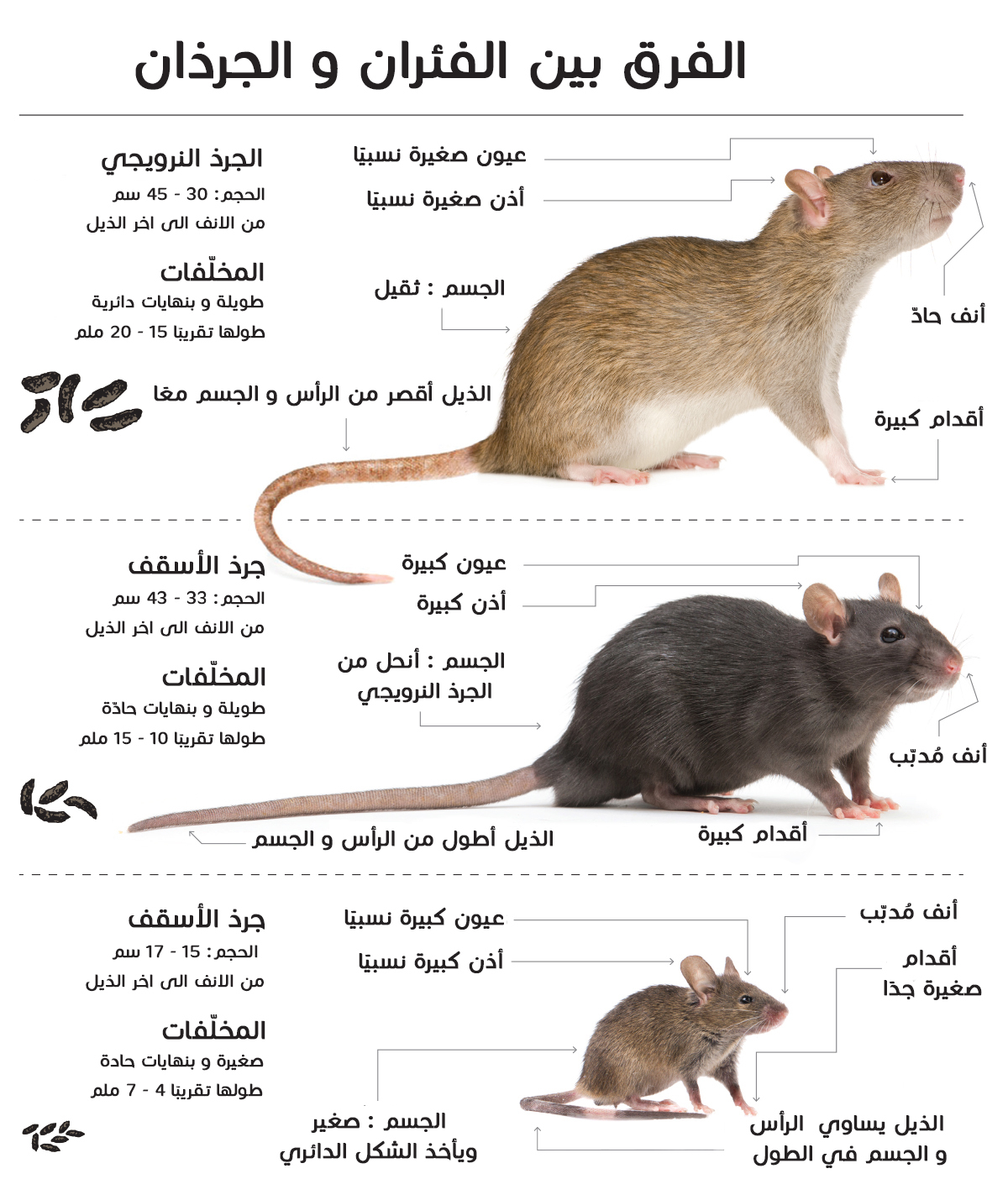
Roof Rat
The Roof rat is slender and agile, able to climb into high places, and its tail is longer than the head and body combined. It may reach a total length of 13 to 17 inches. These rats' nests exist above ground and live in kitchen cabinets, refrigerators, stoves, fireplaces, under sinks, basements, garages, and attics. They prefer to feed on fruits and nuts.
Norway Rat
The Norway rat is larger and more aggressive than the Roof Rat. It has smaller eyes and ears, and its tail is shorter than the length of the head and body combined. It can reach a total length of 12 to 17 inches. Norway rats and their nests live in an underground burrow system and they are generally found in agricultural areas, creeks and sewers. It can also live in buildings, basements, waterfronts, and under wood piles. They feed on garbage and meat scraps, cereal grains, fruits and vegetables.
House Mouse
The house mouse is small and slender, with a tail that is longer than the length of its head and body combined. Its body size ranges from 6 to 7 inches. Its body color is grayish brown with a gray belly. House mice are agile climbers and can enter openings as small as ¼ inch in diameter. It eats many types of food but prefers seeds and grains.
What are the signs of rodent activity?
- Damaged or partially eaten fruits and nuts, such as walnuts, oranges and avocados.
- Signs of biting wood or rubber surfaces.
- Marks on painted or wooden walls as a result of repeated contact with rat's oily fur.
- Rodent droppings are usually signs of high rodent activity.
- Burrows in the ground.
- Noisy or gnawing noises.

What are the damages rodents can cause?
• Rodents can be highly destructive pests as they contaminate food and its surrounding as well as costly physical damage and fires from chewing electrical wires.
• Most importantly, rodents are carriers of many diseases. Rats and mice sometimes bite and this bite can lead to a serious disease if not treated, such as lymphocytic chorioamnionitis. This disease mostly affects those with weakened immune systems and may lead to headaches, fever, and meningitis.
• It can also cause complications during pregnancy. Some people may have an allergic reaction to rat droppings, which can cause asthma-related symptoms. It is not recommended to handle any wild rodents as they have large teeth and are capable of transmitting a variety of bacteria, viruses and diseases through saliva, feces and urine.
In biology, the most common diseases caused by rodents have been identified:
- Food poisoning that may be transmitted when rodents defecate or urinate on food, dishes, floors, and every object human use.
- It is caused by Treponema bacteria, which humans may become infected through the contact with water or ingestion of food contaminated with infected rat urine.
- It is caused by Rickettsia Typhi. It can be transmitted to rodents and then transmitted to human when flea-infected feces come into contact with human skin.

Rodent control by Bash Services
Step 1: Inspect and detect
All areas that rodents can exploit to enter and infiltrate will be inspected. Next, we develop a customized plan that fits the size and nature of the site with considering other important details.
Step 2: Control and protect
Using methods including distribution of traps and baits, rodents will be controlled, and then actions are taken, especially in the entry points for rodents to keep intruding rodents away.
Step 3: Re-inspect and detect
Each visit, we will re-check all areas and check previously secured entry points.

Prevent Rodent Infestation
Following preventive methods in pest control is an essential step to protect ourselves from pests and it’s a part of the Integrated Public Health Pest Control Management (IPM). The success of this system starts from how do behave in the site whether it’s a house or a workplace. These behaviors should include maintaining the cleanliness of the site and storing food. Keep any potential food sources away from rodents. Small food crumbs and remaining food are common sources of infestation. They must be kept in metal or glass containers, in addition to storing fruits and vegetables properly and throwing waste out continuously.
Frequently Asked Questions about Rodent Control
Not seeing a mouse or rat does not mean there is no infestation, as rodents often hide in hard-to-reach places and move during times of lower human activity.
Mice are smaller and can enter through very narrow openings, and may hide inside walls, ceilings, cabinets, and enclosed areas. Rats, on the other hand, are larger and may be found in outdoor areas, storage rooms, service rooms, drainage systems, and areas where food and water sources are available.
Therefore, the method of control varies depending on the type of rodent and where it is active, and not all rodent cases are handled the same way.
Therefore, identifying entry points is an important part of rodent control, as eliminating existing rodents without addressing entry methods may lead to a recurrence of the problem.
After that, a control program is established that suits the nature of the site, which may include the use of traps or bait stations specifically for rodents, with their locations determined based on rodent movement and activity level.
In commercial establishments, restaurants, warehouses, and offices, control points are distributed in an organized manner, taking into account the nature of the activity and sensitive areas.
Factors that contribute to the continuation of the infestation are also evaluated, such as openings, water leaks, food sources, and waste accumulation, in order to reduce the likelihood of rodents returning.
If the source of food or water or entry point remains, rodents may return or continue to exist in hidden areas without being noticed by the residents.
Therefore, when there are clear signs of infestation, it is better to identify the source of the problem and entry points rather than relying on the temporary disappearance of rodents.
Additionally, placing poisons randomly may lead to the rodent dying in a hidden place that is difficult to access, which can cause problems in removing the carcass or unpleasant odors.
In cases of ongoing or large infestations, professional inspection is more suitable to identify activity locations and choose the appropriate control method.
In professional pest control, the locations of bait stations and traps are determined according to the nature of the site and the level of activity, taking into account the areas used by people and animals.
It is essential to adhere to the manufacturer's instructions and the guidelines of the pest control team, and not to move, open, or handle the contents of bait stations inappropriately.
A limited problem may be easier and quicker to address, while large or recurring infestations may require several follow-up visits to ensure activity levels decrease.
Therefore, the duration of the control program is determined after inspecting the site and assessing the level of infestation.
In active infestations, subsequent visits help to check traps and bait stations, monitor activity, ensure rodent numbers decrease, and identify any new signs.
Commercial facilities or sites that are more susceptible to rodents may require a regular follow-up program instead of just a one-time treatment.
Factors affecting the cost include the type of rodents, the size of the infestation, the area of the site, the number of control points, the number of visits required, the nature of the facility, and the need for follow-up.
Therefore, the price is determined after evaluating the site and understanding the level of infestation and the scope of service required.
After that, appropriate control points are identified and bait stations or traps are distributed according to the nature of the facility, taking into account sensitive areas and safety requirements.
The service may include regular visits to inspect control points, record results, and monitor any new activity, which helps in early detection of the problem before it expands.
Individuals can contact the relevant authority when there is a problem that requires reporting. However, if the problem is inside a home, office, or private facility and requires inspection and field control implementation, they can contact a specialized rodent control company.
If an establishment—such as a restaurant, office, warehouse, factory, or commercial facility—requires an annual rodent control program, it may contract with a specialized company to carry out periodic visits and provide continuous monitoring of control points and rodent activity.
However, Bash Services offers rodent control as a specialized service that includes both internal and external treatment, and is not limited to spraying external manholes only. The treatment includes spraying internal and external manholes and drains, along with using other control methods depending on the site condition and level of infestation. The visit includes rodent baits, rodent glue traps, mechanical traps, pheromone traps, and granules in outdoor areas, fields, and around burrows, depending on the nature of the site where entry points for rodents and their activity areas inside and outside the facility/home are treated, followed by monitoring from the engineering team.
Therefore, the main difference is that the free Amman Municipality service focuses on rodent control in external manholes using liquid or powder, while Bash relies on a comprehensive internal and external control program that combines spraying, baits, traps, and appropriate methods for the source of infestation and areas of rodent activity.
The goal at Bash is not just to spray the area, but to identify the source of infestation and control rodent activity, monitoring it until the best possible result is achieved.